
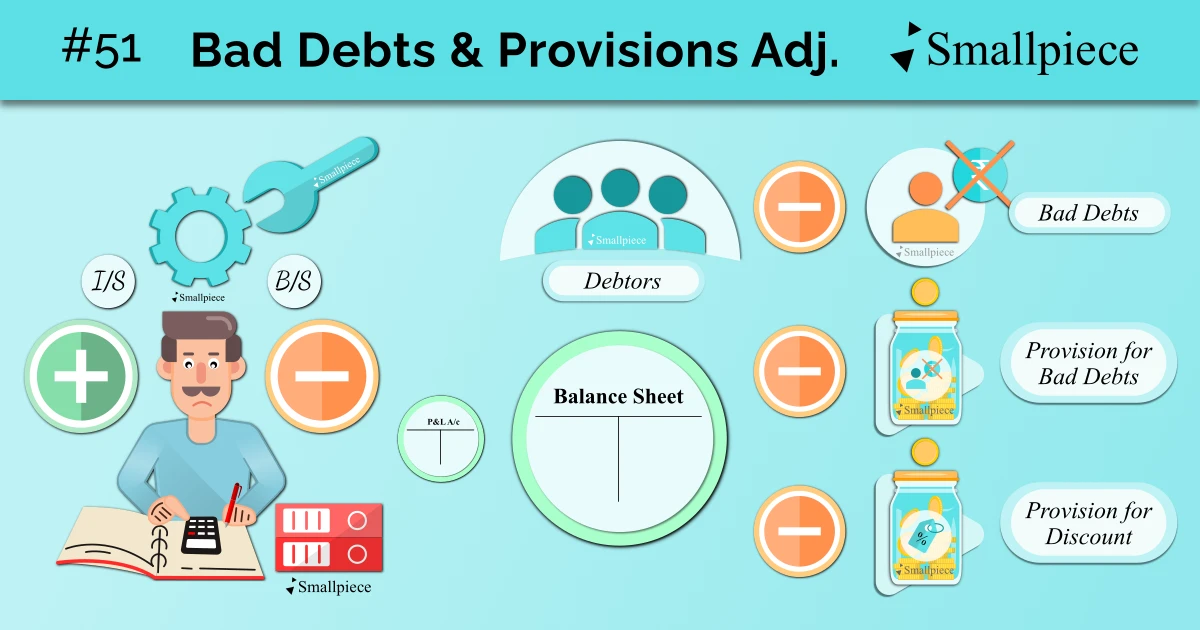
After income and expense adjustments, we must now take a look at some adjustments for losses, beginning with Bad Debts.
Just like how certain expenses become due on the end date of the accounting year, a debtor may declare insolvency on the same, resulting in bad debts for our firm.
This loss, too, must be adjusted for as we make other adjustments on the go.

Bad Debts Adjustment
Bad Debts being a loss are debited and as they represent a decrease in receivables from the debtor(s), the personal account of the debtor(s) concerned will be credited.
Entry:
Bad Debts A/c
Dr.
To Debtors A/c
(Bad debts written off.)
Treatment in Financial Statements:


These bad debts must be added to the already existing bad debts figure (if any) and are subtracted from the debtors’ figure before the adjustment.
Provision for Bad Debts Adjustment
Even for the debtors that remain after subtracting bad debts, there may be some who’ll likely default on a portion of their dues, causing bad debts in the coming year.
Since the prudence concept encourages us to create a cover for such expected losses, firms often maintain a provision for bad and doubtful debts at some percentage of the receivables from debtors that remain on 31st March.

Entry:
Profit & Loss A/c
Dr.
To Provision for Bad Debts A/c
(Provision for Bad Debts created @ x% of debtors.)
Provisions have an effect of reducing the income that owners may take home and thus, appear on the debit side of the Profit & Loss Account. To achieve this desired position, Profit & Loss account is debited in the adjustment entry while the concerned provision (here, the provision for doubtful debts) is credited.
Treatment in Financial Statements:
Since the position of the provisions in P&L has already been discussed, let us take a look at Balance Sheet.
While explaining the layout & components of balance sheet, I mentioned that provisions (the ones tied to assets) appear together with the concerned asset as a deduction. This holds true in case of Provision for Doubtful Debts, which appears as a deduction to the net (actual) debtors’ figure arrived at after adjusting for bad debts.


Running Provision – Previous Balance
Since provisions are maintained across accounting years, it is very much possible to already have a running provision for doubtful debts.
In such a case, it is ideal that we put the provision to its intended use and offset the loss arising out of total bad debts. Then, we can compare the fixed percentage requirement and make up for any shortfall from the Profit & Loss account.
All these complicated calculations are limited to Profit & Loss Account only; nothing changes for Balance Sheet.
Let us take an example to understand.
The Trial Balance of ABC Trading for the year ended 31st March,2026 includes the following balances:
Balances
Amt. (₹)
Debtors
3,05,000
Bad Debts
5,000
Provision for Bad Debts
20,000
We are supposed to make the following adjustments when placing the Trial Balance items in our financial statements: Further Bad Debts of ₹ 3,000 and maintain provision for bad debts @ 10% of debtors.
But for better understanding of the calculation, we will also create the ledger account of Provision for Bad Debts.
Let us begin with the adjustment entry for further bad debts.

Adjusting the further bad debts raises the total figure to ₹ 8,000 (i.e., 5,000 + 3,000). This balance would usually be closed and brought to the debit of Profit & Loss A/c under “Other Expenses & Losses”. But since we have a running provision for bad debts housing ₹ 20,000 , we’ll close this loss in our provision and offset it, which leaves ₹ 12,000 in the provision.


Next, we take a look at the fixed percentage to be maintained in the provision, which is 10% of debtors, post the bad debts adjustment. Upon calculating, it comes to ₹ 30,200 (i.e., 10% of 3,02,000)

We already have ₹12,000 in the provision so the net amount we need to take out from Profit & Loss comes to ₹ 18,200 (i.e., 30,000 – 12,000)


Let us look only at the Ledger account now. We can say that different from other accounts where we calculate the balance, for Provisions maintained on a fixed percent, the balance is decided, we just need to calculate the net amount to be charged from Profit & Loss A/c.

Treatment in Financial Statements:
Whatever calculations we did regarding the running provision are limited to Profit & Loss Account. For Balance Sheet, the facts remain unchanged:
- Take out ₹ 3,000 from the debtors figure of ₹ 3,05,000 pre-adjustment.
- Maintain Provision for Bad Debts @ 10% of the net debtors figure.


Provision for Discount Adjustment
Just like how we create a cover for future bad debts, a loss, we must also create a cover for the discounts that will be offered to our debtors upon making cash payments.
Like the provision for bad debts, it is also created out of the Profit & Loss Account but unlike it, the fixed percent requirement for this provision is not calculated on the total debtors’ figure.
Being tied to payments, we must have a debtors’ figure where default is unlikely, which is why we deducted provision for bad debts from the total debtors earlier. This deduction leaves us with “Good Debtors” who are likely to follow-up on their payments without default and will have to be given discount on the same.

Entry:
Profit & Loss A/c
Dr.
To Provision for Discount A/c
(Provision for Discount created @ x% of debtors.)
Treatment in Financial Statements:


Continuing the example from earlier, let us say that we are also required to create a provision for discount @ 5% on debtors.
The “debtors” here, refer to the good debtors, arrived at after deducting the provision for bad debts (i.e., ₹ 2,71,800).



That is it for the adjustments today. I know it was a relatively long discussion but, it was essential to cover all these together to establish the correct sequence. We’ll meet for the few remaining adjustments soon
Academic Reference
NCERT Class 11 Accountancy, 2026-27 Reprint, Chapter 9 Financial Statements-II, Topics 9.8 to 9.10
https://ncert.nic.in/textbook.php?keac2=2-2

Leave a Reply