
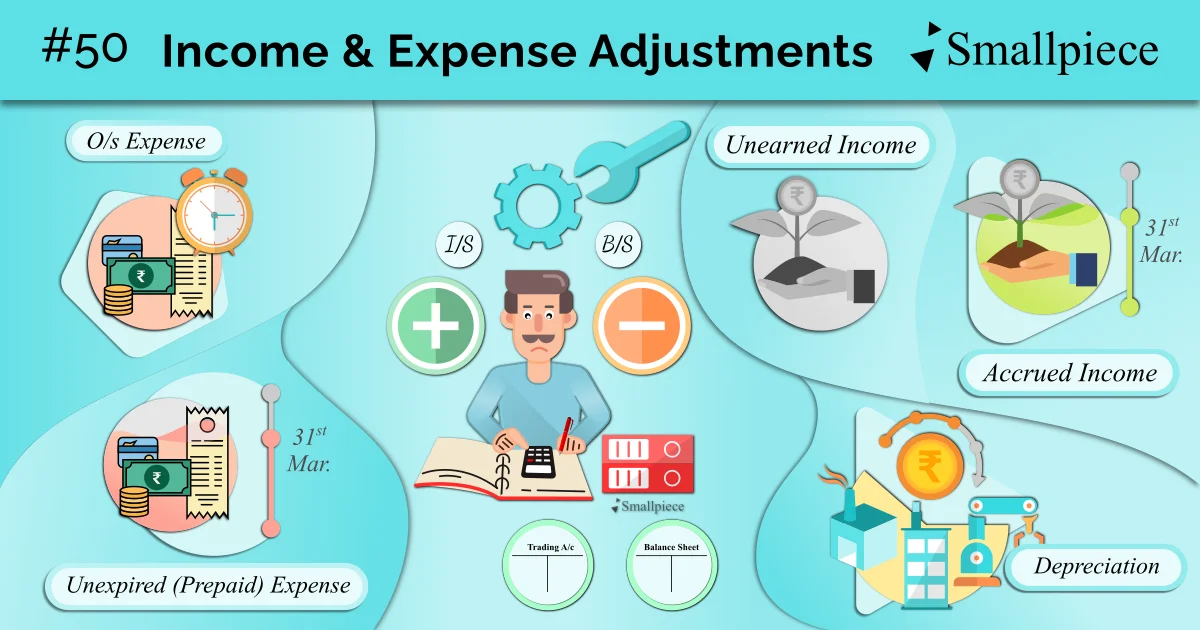
After closing stock, here, we’ll take a look at income and expense adjustments. These are adjustments that we’ve already learnt as special entries while discussing journal.
Let us first take the case of Outstanding expenses.
1. Outstanding Expense Adjustment

In the context of adjustments, these refer to expenses left unpaid at the end date of the accounting year.
Accrual concept allows for recording of such due but unpaid expenses as a form of liabilities.
Entry:
Expense A/c
Dr.
To Outstanding Expense A/c
(Expenses due but not paid.)
Treatment in Financial Statements:


2. Unexpired or Prepaid Expense Adjustment
These are future expenses which have been (in part, or full) paid for in advance.
Prepaid expenses refer to spends for those benefits / services which we’ll start receiving in the upcoming accounting year.
On the other hand, unexpired expenses refer to spends whose benefits / services we’re currently receiving and are likely to do so in the coming year.

This distinction is just for informational purposes. As far as accounting treatment is concerned, there is virtually no difference between the two. In the academic world, usually, only the ‘prepaid’ prefix is used.
Now, onto the adjustment entry & financial statements
They are treated as assets and have to be deducted from the total expense figure.
The expense may belong to either the Trading A/c or the P&L A/c. So, use one depending on the expense item concerned.
Entry:
Prepaid or Unexpired Expense A/c
Dr.
To Expense A/c
(Adjustment for prepaid / unexpired expense.)
Treatment in Financial Statements:


3. Accrued Income or Income Receivable Adjustment

These refer to amounts that rightfully belong to us but will be received in the coming year.
Here, too, the accrual concept allows them to be recognised and recorded as assets.
Adjustment Entry:
Accrued Income or Income Receivable A/c
Dr.
To Income A/c
(Income earned but not received.)
Treatment in Financial Statements:


4. Unearned Income or Income Received in Advance Adjustment

These refer to money that we’ve received before providing the goods / services agreed upon and hence, the word “unearned”.
Since, we have an ‘obligation’ to keep our end of the agreement, such items appear as liabilities and have to be deducted from the relevant income item.
Adjustment Entry:
Income A/c
Dr.
To Unearned Income A/c
(Adjustment for unearned income.)
Treatment in Financial Statements:


5. Depreciation Adjustment
Born out of the matching concept, depreciation represents a gradual fall in the value of assets (huge spends) rather than recognising the entirety of the spend as an expense in the year the payment was made.
It is seen as a non-cash “expense” and is accounted for just like one.

Adjustment Entry:
Depreciation A/c
Dr.
To Asset A/c
(Depreciation @ x% p.a. charged on asset.)
Treatment in Financial Statements:


Academic Reference
NCERT Class 11 Accountancy, 2026-27 Reprint, Chapter 9 Financial Statements-II, Topics 9.3 to 9.7
https://ncert.nic.in/textbook.php?keac2=2-2

Leave a Reply