
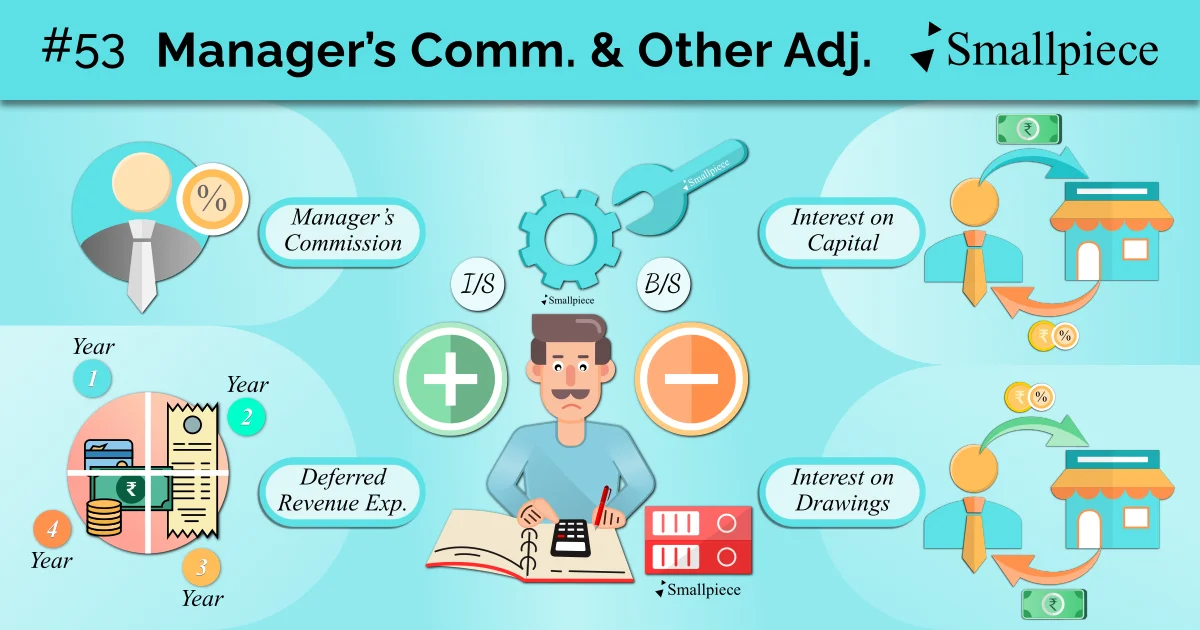
Today will be the last discussion we have in our series of adjustments.
Let us begin with an adjustment called manager’s commission.
1. Manager’s Commission Adjustment
Based on the name, let’s create a fictional scenario in our head. Sole proprietorship, despite being a one-man show, doesn’t stop the owner from hiring people. With growth in the business, owners do hire employees, though not in large numbers like companies. And among these employees, there may be one who is entrusted with the role of a manager: overseeing the business in the proprietor’s stead.
To motivate managers to strive for better, incentives are offered in addition to their fixed salary, which may include a profit share, a bonus, commission, etc.
For us, the incentive of interest is the commission. As you might already be aware, commissions are usually offered as a fixed percent of some base figure.
The base figure may be net sales, gross profit or net profit.
Whatever base we choose, an important point to note is that being an adjustment, manager’s commission is only determined on the 31st of March and not paid out i.e., we only arrive at a commission figure which remains outstanding till paid.

Thus, the entry and treatment for manager’s commission is the same as adjustment for any other outstanding expense.
Entry:
Manager’s Commission A/c
Dr.
To Outstanding Manager’s Commission A/c
(Manager’s commission @ x% on sales / profit due.)
Treatment in Financial Statements:


Ways to calculate Manager’s Commission:
In case the manager’s commission % is based on net sales or gross profit, it is relatively simple.
But, when it is calculated relative to net profit, there are two manners in which the commission figure may be calculated:
a. As a % figure of the overall net profit figure, before deduction of such commission
b. As a % figure of what the company will keep (the true net profit) following this commission expense.
Let us take a look at both these cases.
(A) Commission on Profits before charging such commission:
This is a simple method. After finding the net profit, just calculate a certain percentage of it as a commission.
For example, say the firm’s net profit is ₹ 100 and the manager’s commission is calculated @ 10% on profits before deduction of such commission.

Thus, in this case, the manager would receive ₹ 10 out of every ₹ 100 of profit and the firm would keep ₹ 90.
(B) Commission on Profits after charging such commission:
Here, rather than calculating the commission on profit before giving commission, it is calculated at profit after commission.
Suppose, the manager’s commission rate is the same (i.e., 10%) but, on profit after deduction of such commission.

In this case, the manager’s commission would be ₹ 10 on every ₹ 110 of profit and the firm would keep ₹ 100 out of the same.
2. Deferred Revenue Expenditure
Certain expenses occur on a regular basis, take for example, advertisement but they may continue to run past the accounting year, similar to the example of prepaid insurance we saw in one of our previous meets.
Deferred revenue expenditures refer to spends that not only go past the current accounting year, but provide benefits for multiple years thereafter.
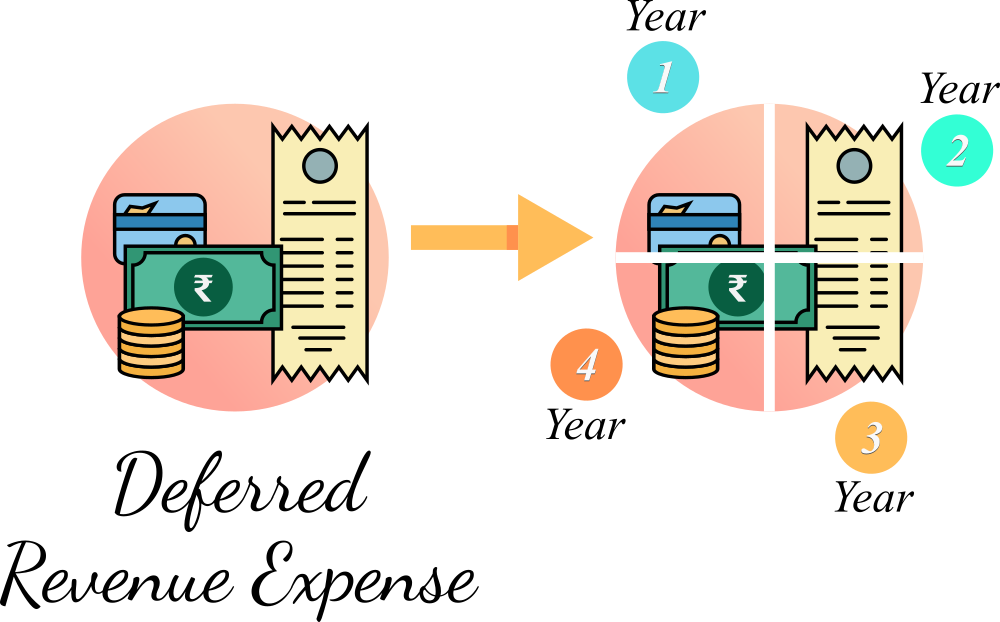
Suppose a firm has entered into a contract with an ad agency to run advertisements for 4 years and as per the terms, is required to pay the contract amount upfront.
We cannot recognise the entirety of such a spend as an expense rather, we delay or ‘defer’ recognising the expense and only do so in parts.
The contract sum paid is first recorded as an asset and will be slowly ‘written off’ with each passing year.
Entry:
Profit & Loss A/c
Dr.
To Advertisement Expense A/c
(1/4th of advertisement expense written off.)
Treatment in Financial Statements:


3. Interest on Capital Adjustment
I hope you remember that there are two sources of funds for a business: Owner’s Funds & Borrowed Funds.
The main distinction between the two is that owners’ funds usually have no fixed charge attached to them, unlike borrowed funds that come with interest obligations.
But, since owners, too, act as a source of funds, why should they not enjoy any returns?
Thus, some businesses may have this practice of providing interest on capital, too, which would be the case had the funds been borrowed from banks & financial institutions.
The interest rate may be kept lower than the rates usually offered on business loans but it would provide some sort of return to the owners who would otherwise have to live in uncertainty of whether there would be enough profit left for them to take home, especially taking into account provisions & reserves.

Entry:
This interest reduces profits for the business and raises the amount that it owes to the owner.
Interest on Capital A/c
Dr.
To Capital A/c
(Interest on capital provided @ x% of capital.)
Treatment in Financial Statements:


4. Interest on Drawings
It is the counter of interest on capital.
In case the owner gets interest on his capital, the business too has the right to charge interest in case he withdraws any money meant to stay in business.
This results in further reduction in capital, which too is recorded under the head of Drawings.
Suppose the owner withdraws ₹10,000 and is charged 10% on drawings, then the total reduction in capital recorded under the Drawings account will be ₹11,000, comprising of both the cash and the interest.

Entry:
The adjustment entry for the interest part may be made as under:
Drawings A/c
Dr.
To Interest on Drawings A/c
(Interest on drawings charged @ x% of drawings.)
Treatment in Financial Statements:


With this, we have completed all our adjustments: total 17 in count. This also marks the end of our discussions on the accounting cycle that we’ve had taking the case of a basic sole proprietorship in hand.
I’ve prepared a document containing two illustrations that almost cover all these adjustments. Do go through the document and see how adjustments are made practically as your final task in this last discussion.
But at this point, I must also tell you that apart from manager’s commission, the other adjustments here are something I’ve covered only because they are taught academically but don’t make much sense in our basic nature of sole proprietorship.
For example, the above justification that I provided for allowing interest on capital is just made up. Just think; won’t providing interest go against the very nature of owners’ funds in a sole proprietorship?
Interest on capital is usually seen as a distribution or appropriation of profit and cannot be paid out in case there is no profit (similar to how returns usually work in case of borrowed funds).
Thus, providing interest on capital virtually makes no difference; it only shows the amount of net profit left in case the business was working with borrowed funds.
Same is the case with interest on drawings. Sure, it reduces owner’s capital, but it would also be closed as a gain in the Profit & Loss account which increase the net profit and net profit, as we know, goes to the owner’s capital at the end.
Rather than sole proprietorship, interest on capital and drawings make more sense in the “partnership” form of business where clear distinctions are made between charge against profit (i.e., actual expenses & losses) and appropriations of profit (i.e., distribution of profit to owners / partners under different names, one being interest on capital).
Apart from accounting for partnership form of business, there is also the topic of “Subsidiary Books” that we haven’t discussed.
But, these are all things for the future, if time and money allow. I hope the discussions we’ve had were useful to you. Do share them with your classmates or anyone who is curious or just confused and wants to begin learning accounting through small and interconnected discussions.
Bye for now!
Academic Reference
NCERT Class 11 Accountancy, 2026-27 Reprint, Chapter 9 Financial Statements-II, Topics 9.11 & 9.12
https://ncert.nic.in/textbook.php?keac2=2-2

Leave a Reply