
After understanding the layout and components of the income statement, or as we last saw it, the “Trading and P&L Account”, we should be doing the same for our second financial statement: the Position Statement a.k.a. the Balance Sheet.
But, there’s a component of the Balance Sheet that we must discuss beforehand.
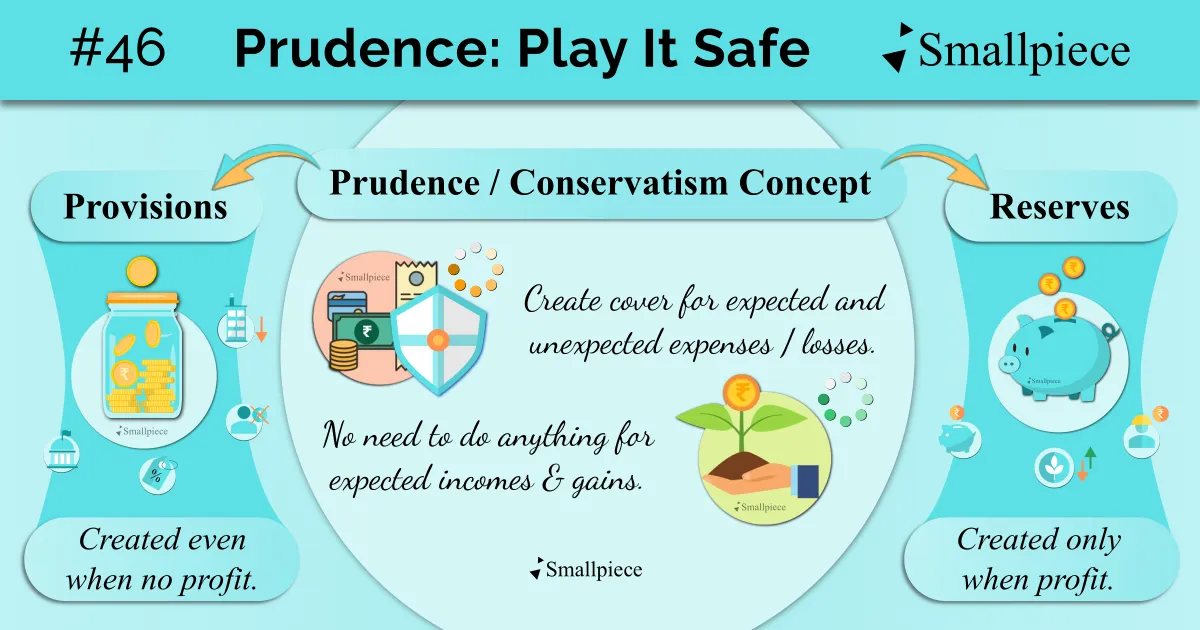
Just like how Income Statement included various categories of incomes & expenses, namely, admin expenses, selling expenses, etc., Balance Sheet, too, has its set of categories. One such category is called “Reserves & Provisions”, which was born out of yet another important accounting concept: the “Prudence Concept”.
The motto of this concept is to “Play It Safe”.
To describe further, it states that if we expect any losses to arise in the future, rather than just sitting around, we should start making some preparations to deal with them.
And, how exactly, should we deal with them? By keeping some money aside now.
What followed from this concept is the practice of taking aside a certain sum from the owners’ profit and letting it stay in the business. In some situations, ‘provisions’ are made, even without the certainty of profit in the running year.
On the flip side, if we expect some additional income, say, on account of rise in market value of our investments, what do we do then?
Nothing. Just sit tight and let the income arise.

The main idea behind the prudence concept is to make our business strong enough to withstand expected & unexpected shocks in the future.
This defensive approach is also referred to as the “Conservatism Concept” in various accounting texts.
Provision
Going to its roots, provision means “to foresee”.
If I were to expand on this meaning and use it in the accounting context, a provision refers to a sum of money set aside to cover expenses or losses that the business / owner foresees occurring in the future, though the ‘exact’ amount of said expenses may not be predictable at the moment.
For e.g., it is almost certain that there will be some bad debts among the debtors in future, though the exact amount of these bad debts cannot be predicted.
Due to the strong possibility of occurrence, provisions are created “even when there is no profit”.

Examples of Provision:
1. Provision for Bad and Doubtful Debts, created to cover the loss on bad debts that may arise in future.
2. Provision for Discount on Debtors, created to cover the loss on giving cash discounts in future.
3. Provision for Depreciation
4. Provision for Taxation

Reserve
Reserve, when tracing its roots, simply means to “keep”.
We can expand on this and say that in accounting, a reserve refers to a portion of profit that is kept in the business to strengthen its financial position vis-a-vis growth-expansion plans and possible future events, like workmen accident compensation, investment devaluation, etc..
Since reserves are created out of profits, they are also known as ‘Undistributed Profits’ and cannot be created in case of no profit.
Examples of Reserves:
1. General Reserve: A reserve that can be used for any purpose.
2. Investment Fluctuation Fund, to cover for unexpected fall in the market value of investments.
3. Workmen Accident Compensation Fund, to cover for compensation payable to a worker in case of any future accident.
4. Reserve Fund: A portion of profit that is invested outside the business; in assets that can be quickly converted to cash whenever required.

That is all for this brief introduction to reserves & provisions. We can now move on to understanding the layout of the Balance Sheet.
Academic Reference
1. NCERT Class 11 Accountancy, 2026-27 Reprint, Chapter 2 Theory Base of Accountancy, Topic 2.2.11
https://ncert.nic.in/textbook.php?keac1=2-7
2. NCERT Class 11 Accountancy, 2026-27 Reprint, Chapter 8 Financial Statements-I, Topic 7.11 onwards
https://ncert.nic.in/textbook.php?keac1=7-7

Leave a Reply