
Till now, we’ve gone through the entire accounting cycle, right from journal to financial statements. Within this cycle, there’s a small step we’re yet to touch upon.
If we look back, there are something called “adjustments” that I’ve made in the ledger accounts and financial statements: the ones for closing stock and prepaid rent.
During the course of the accounting year, there are certain items that are left for the end of year to make life easier. A broader example is the calculation of P&L, that we usually postpone till the end of year, or quarter. Apart from this, there are smaller things like stock left unsold, portion of prepaid expenses, expenses due, incomes receivable, etc.
It is possible for all these items to already have their ledger accounts before the 31st of March.
But another hassle-free way is to account for most of them only at the end of the year.
For example, prepaid expenses like prepaid rent may be recognised at the date of transaction itself and subsequently, parts will be adjusted towards the rent expense. But, another way of going about this is to recognise the prepaid portion only at, say, the year end. This reduces the number of entries that we would’ve make in the first case.
Further, there are certain expenses that may only become due on the last day of the month. Suppose, employee salaries in a certain business become due on the last day of the month and till they are paid in the next month, they’ll stay as a liability on the firm’s balance sheet.
Then, there’s depreciation, which is usually recorded only at the end of accounting period, representing a gradual decrease in the value of asset during the same.
Thus, as in any sort of work activity, there are last-minute adjustments or should I say, last-day adjustments in accounting too. And, as the concept implies, the journal entries made to account for them are known as “Adjustment Entries”.

When information is available regarding the necessary adjustments to be made, we can create a new trial balance after making these entries or we can simply continue from the old one and make direct adjustments to the financial statements on the go.
In the academic world, adjustments usually appear as “additional information” to the Trial Balance and we are required to prepare the financial statements, keeping in mind the impact of such adjustments.
Now, we’ll start discussing various such adjustments and their effect on the financial statements of the business, beginning with Closing Stock.
Closing Stock Adjustment

The term ‘Closing Stock’, as we know, refers to the stock that is left unsold at the end of the accounting year.
In our last discussion on closing entries, I said we’ll discuss closing stock later. It is now time.
Closing Stock, unlike other items, is not closed but brought into existence through the adjustment entry which is today’s topic.
In our example of Hitesh Traders, I brought it into existence by adjusting it out of purchases, which is why it didn’t appear in the Trading Account described in the solution handout.
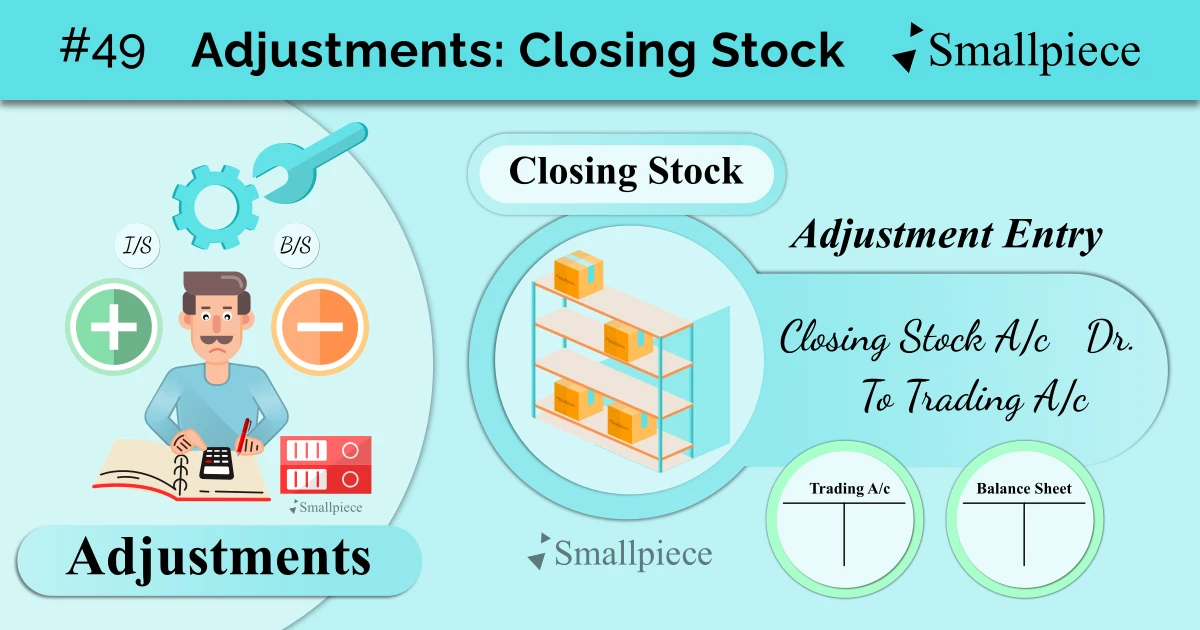
Another way to adjust closing stock is to so directly with the Trading Account. In the adjustment entry, closing stock, being an asset is debited and the credit part will be filled by Trading Account.
Adjustment Entry
Closing Stock A/c
Dr.
To Trading A/c
This entry, when posted, brings closing stock to its rightful place on the credit side of the Trading Account. And, of course, since closing stock is an asset, it appears on the assets side of the balance sheet.


For the sake of simplicity, I will not be using the current & non-current categories in B/S (or, the categories in I/S) while explaining the adjustments. But do not think you can forget them.
Apart from closing stock, all the special entries (be it the ones for goods or the other ones) that we’ve learnt in journal also appear as adjustment entries. Next up, we’ll take up a few adjustment entries, ones tied to incomes & expenses.
Academic Reference
NCERT Class 11 Accountancy, 2026-27 Reprint, Chapter 9 Financial Statements-II, Topics 9.1 & 9.2
https://ncert.nic.in/textbook.php?keac2=2-2

Leave a Reply