

Since we have talked about entries for buying and returning things, I would like to draw your attention to probably one of the most ignored things in business: The Law.
Suppose, a dispute arises between two traders regarding the return of goods and refund and they take this to court. The seller can simply claim that the other person didn’t even buy from him so there is no question of any refund. When the judge asks the buyer, “What proof do you have to back your claim?”, what indeed can the buyer present to counter this false narrative?
A single piece of paper; a bill.
In simple words, a bill is a piece of paper containing the details of the trade between two parties and the amount that a customer has to pay for the goods or services purchased.
So, how do we account for transactions when a bill is involved?
Treatment of Bills Receivable & Bills Payable
A bill is payable for a customer and receivable for a seller.
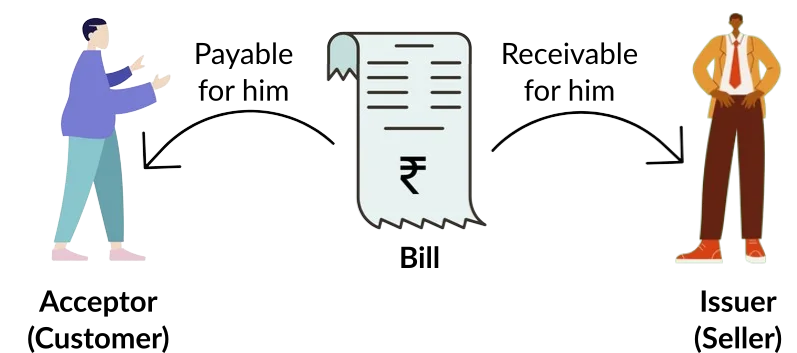
When we involve a bill in accounting, our creditors get converted to Bills Payable and debtors to Bills Receivable. This need for making separate accounts for bill arises only in credit transactions. As far as cash transaction is concerned, no separate account for bills is needed because in case of cash transaction, a bill is paid instantaneously.
Journal Entries
1. Purchase and Sale of Goods on Credit
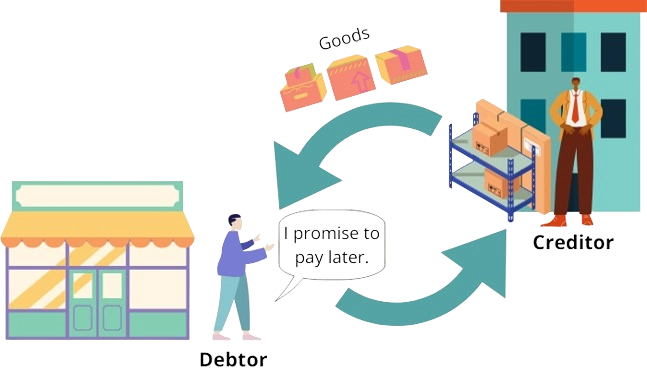
This we have already discussed previously but let us revise. When a buyer makes a promise of paying at a future date, he becomes a debtor to the seller and the seller becomes the creditor to the buyer.
For the debtor, his stock of goods (an asset) increases which is debited under the head of Purchase and so does his liability of making payment to the creditor, which is credited.
On the other hand, for the creditor, his stock of goods decreases which is credited under the head of Sales and secondly, his receivables in the form of debtors (an asset) increase which is debited.

2. Bill drawn (issued) by seller and accepted by customer
Here, we need to update the status of seller from Creditor to Bills Payable and customers from Debtor to Bills Receivable.
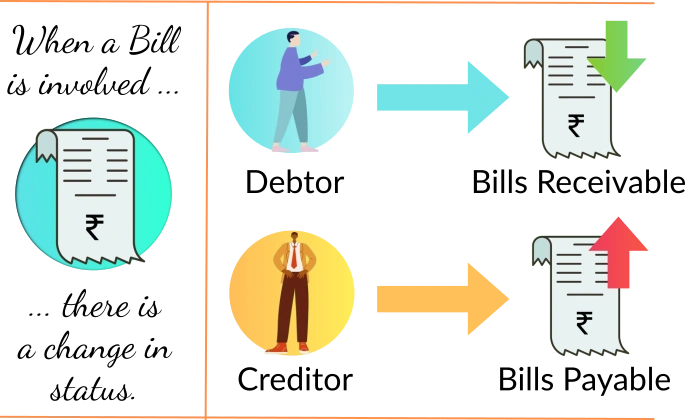
Since we want to delete a name from our list of creditors (a liability), we’ll give the debit tag to creditors and on the credit, we’ll write Bills Payable. At the end, the name of the seller retains its core identity as a liability in the books of the buyer.
Similarly, if we were to take a look at this from the seller’s lens, we need to delete a name from our list of debtors and transfer it to Bills Receivable. To do so, we would need to credit the Debtors item and debit Bills Receivable. Just as above, the customer’s name retains its core identity as an asset, just under a different name.

3(A). Bill is honoured i.e., customer pays on time

Then, the customer’s liability goes away and so does the seller’s asset.
Whenever there’s a decrease in liability (here, Bills Payable for the customer), we debit it and when there’s a decrease in asset (here, Bills Receivable for the seller), we credit it. Depending upon the mode of payment, use Cash or Bank item to record the opposite effect.

3(B). Bill is dishonoured i.e., customer does not pay on time

The status of the customer as Bills Receivable and that of the seller as Bills Payable lasts only for a limited time; till the end of what we call Credit Period i.e., the time period under which the customer has to fulfill his promise of making the payment. It may be 30 days, 45 days, 60 days or whatever.
But after it ends (including the grace period i.e., some additional days, if allowed), the status of customer and seller is rolled back to Debtor and Creditor respectively.

This was a basic overview of how we can make journal entries for when bills are involved.
But it is also at this point that I must state that the above entries are what the syllabus teaches you. In the practical world where we maintain our accounts on computers through specialised accounting software, debtor/creditor and bills receivable/payable are not so isolated.
Let us consider Tally, one among the accounting software that exist today. In it, when we make entries for purchase and sale, be it on cash or credit, we get an option to input the bill / invoice no. by default. Thus, the need for making separate accounts for Bills Payable and Bills Receivable is almost non-existent.
More importantly, unlike before, bills are more or less mandatory in today’s world, unless you like to under-report sales to evade taxes.
That is all for this post.

Leave a Reply